LLM EVAL
Fixed-Budget Tool-Use DPO: Call Correctness and Follow-Up Decisions
Ilho Ahn
Under matched training budgets, structure-focused DPO led call correctness and decision-focused DPO led behavior selection. Repeated recipe rankings are examined alongside correct and incorrect follow-ups.

A tool-use model must select the correct function and arguments, and decide when missing information calls for a follow-up question or an unable-to-answer response. This note asks whether the same training recipe leads on both abilities under a matched budget, and which behavior differences accompany the score gaps. It compares structure-focused and decision-focused DPO recipes from the same Qwen3-8B supervised checkpoint [1].
The lead depended on the evaluation: structure scored higher on call correctness, while decision scored higher on aggregate behavior selection. Those directions held in repeated checks. In the original runs, decision had both more correct follow-up labels and more incorrect follow-up labels. The two results developed here are the repeatability of the recipe-level score gaps and the behavior-specific gains and errors within those scores.
Tool-use DPO applies Rafailov et al.’s Direct Preference Optimization to preferred and dispreferred tool-use responses [2]. A recipe specifies the data source and response-pair construction. The shared SFT baseline is the supervised checkpoint before DPO and also serves as its frozen reference model.
Summary
- The recipes had different strengths under the same training budget. In the quality-gated 50-step comparison, structure led BFCL call correctness by
3.33percentage points (pp), while decision led When2Call macro F1 by5.31pp. - The decision recipe had more correct and incorrect follow-up labels. In the original runs, structure and decision correctly labeled
32/100and57/100follow-up cases, respectively. Decision correctly labeled fewer tool-call and unable-to-answer cases. - The aggregate score directions repeated. Each recipe retained its advantage across three training seeds and one reconstructed pair pool. The behavior-class breakdown covers only the original runs.
- The comparison does not isolate the effect of training on a particular error type. Prompts and chosen responses differ between recipes, and the decision training data belongs to the same When2Call family as the evaluation. The main checkpoint was also selected after inspecting results.
Experimental Setup
The comparison is between two recipes that differ in data source and response-pair construction. A common starting point and matched pair and update budgets support the recipe comparison; per-prompt scoring rows show which behaviors differ.
The shared SFT checkpoint was trained on 70% xLAM/APIGen, 20% ToolACE, and 10% When2Call. The two main DPO recipes and their unfiltered controls use the same settings [3]:
- Training budget:
3000preference pairs and375optimizer steps per run. - Optimization: beta
0.1, learning rate5e-6, LoRA rank16, and effective batch size8. - Checkpoints: the 50-step checkpoint, selected for the main comparison after inspecting results, and the final checkpoint after the full budget. Appendix B covers the auxiliary checkpoint, filtering, and source-mixing comparisons.
Pair count and optimizer steps are matched; source distributions, prompts, and loss-bearing token counts are not. The budget is a control on the comparison, not a measurement of equal compute cost.
Recipe Construction
Table 1 summarizes the pinned pair-construction rules. Chosen responses come from each source’s reference output; prompts and chosen responses were not matched across recipes.
| Recipe | Pair source and rejected-output construction |
|---|---|
| Function-call structure | Gold tool-call responses are altered to introduce a wrong function, required argument or value, call count, or material type/schema error. The public artifacts call this source noised_gold. |
| Call decision | When2Call-family decision examples pair the reference response with an incorrect call/no-call decision, unnecessary follow-up, abstention, or answer-completion error. The public artifacts call this source behavior. |
Quality-gated conditions remove ambiguous or equivalent pairs, acceptable alternatives, and suspect reference responses. Each source passes an LLM-assisted holdout audit of at least 100 selected rows; this is quality control, not human annotation. Ungated controls are sampled before that semantic filter, with trainability-only exclusions.
Evaluation Slices and Metrics
Table 2 defines the evaluation slices. BFCL assesses call correctness [4], while When2Call covers call-decision tasks [5]. The IFEval-style prompt-strict diagnostic is derived from IFEval [6]: a prompt passes when all instructions supported by the local evaluator pass. Unsupported instructions are omitted, and prompts with none supported are excluded.
| Evaluation slice | Evaluated prompts | Selection and scoring |
|---|---|---|
| BFCL core | 300 |
First 60 rows from each of five BFCL v3 categories: simple, multiple, parallel, irrelevance, and live multiple. Exact-match function-call correctness under the fixed local parser and evaluator. |
| When2Call | 300 |
From the test configuration's MCQ split: 100 tool-call, 100 follow-up, and 100 unable-to-answer examples. Macro F1 uses behavior labels assigned by tool-call parsing and deterministic text heuristics. Response exact match additionally checks call correctness on tool-call rows. |
| IFEval-style Prompt-strict diagnostic |
96 |
First 100 source prompts, with 4 excluded because the evaluator supports none of their instructions. Accuracy requires all supported instructions in a prompt to pass. |
The public metric named When2Call_behavior_accuracy averages the released exact_match flags. A correct call decision can still fail this metric because of a wrong function, argument, or call count. This note labels it W2C response exact match. Behavior-label accuracy instead compares expected_behavior with observed_behavior; macro F1 also uses these labels. The released computation keeps these two scoring paths distinct.
The frozen macro-F1 evaluator includes direct answer as a zero-support class with zero_division=0. The coverage audit found no direct-answer gold rows among 3,952 labeled test rows; another 24,000 inspected training rows had no exposed behavior gold labels. That 27,952-row audit does not enlarge the 300-prompt model evaluation or establish training-label coverage.
DPO evaluations share deterministic decoding (do_sample=false) with thinking disabled (enable_thinking=false). The reported 95% confidence intervals (CIs) use paired, prompt-ID-grouped percentile bootstrap with 1000 resamples. They describe evaluation-sample uncertainty conditional on the runs, excluding training and checkpoint-selection uncertainty. The separate SFT comparison requires the generation-limit qualification in Appendix A.
Results
Different Leaders on Call Correctness and Behavior Selection
In the quality-gated 50-step comparison, structure led BFCL call correctness and decision led When2Call (W2C) macro F1. In structure–decision order, BFCL was 0.713 versus 0.680, and W2C macro F1 was 0.477 versus 0.530. Table 3 expresses the gaps as structure minus decision: positive BFCL and negative W2C values indicate their respective advantages. The ungated controls show the same directions.
| Condition | Metric | Score difference (pp) | 95% CI low | 95% CI high |
|---|---|---|---|---|
| Quality-gated | BFCL core | +3.33 |
+1.53 |
+5.67 |
| W2C response exact match | -6.67 |
-10.75 |
-3.02 |
|
| W2C macro F1 | -5.31 |
-8.85 |
-2.34 |
|
| Ungated control | BFCL core | +2.67 |
+1.02 |
+4.86 |
| W2C macro F1 | -4.21 |
-7.48 |
-1.23 |
The same aggregate directions held across three training seeds and one reconstructed pair pool (Table 4). This supports a repeatable difference under the tested settings. The reconstructed pool still shares prompts with the original, and these checks do not isolate source effects from prompt composition.
| Check | Observed result | Scope |
|---|---|---|
| Training seeds | Same direction across three seeds. Gap ranges (pp): BFCL 3.00–4.00; W2C response exact match 5.00–6.67; W2C macro F1 4.26–5.31. |
Fixed pair pool only. |
| Reconstructed pair pool | No pair-id or content-hash overlap; prompt-id overlap was 401/3000 and 1337/3000.Reconstructed-pool gaps (pp): BFCL 3.33; W2C response exact match 6.33; W2C macro F1 5.04. |
One reconstruction; prompts are not independent. |
More Correct Follow-Ups, More Follow-Up Errors
Repeated aggregate rankings do not show which recipe leads within each behavior class. Figure 1 compares correct labels by class; the following per-prompt analysis then examines where incorrect follow-up labels occur.
Figure 1 recounts behavior-label matches in the original quality-gated 50-step structure and decision runs. The 300 prompt IDs and hashes match between files. Each gold class contains 100 prompts, so the counts also give class recall in percent. This is a post-hoc breakdown of those two runs; the repeated aggregate checks do not establish that every class-level pattern repeats.
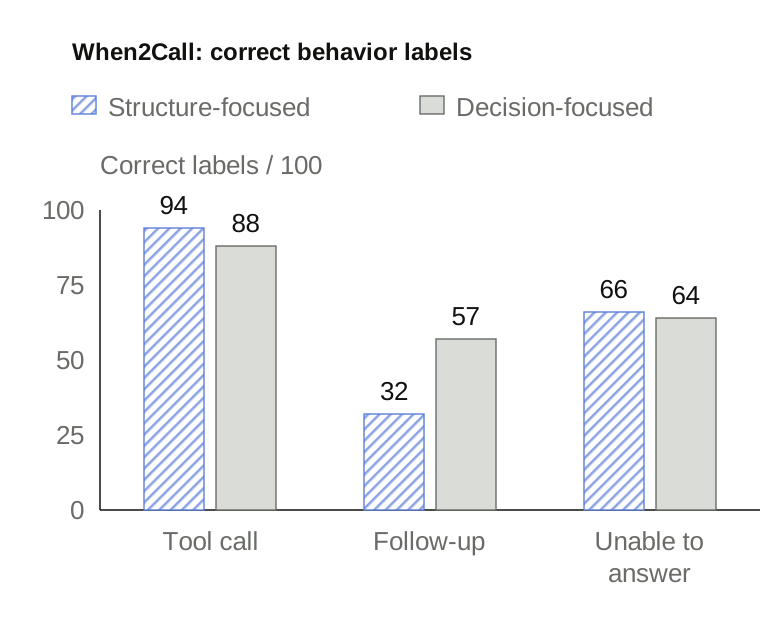
The largest correct-count gap in Figure 1 is in follow-up cases. Matching the scoring rows by prompt shows that the decision recipe correctly labels 25 additional prompts: the structure recipe labeled 22 of these as tool calls and 3 as unable to answer. Erroneous tool-call labels on this class number 61 for structure and 36 for decision. Conversely, erroneous follow-up labels on tool-call or unable-to-answer cases number 3 and 20, respectively. Decision therefore identifies more prompts that require a follow-up, while also misclassifying more prompts whose correct behavior is something else.
Summing the correct labels in Figure 1 gives behavior-label accuracy of 192/300 (64.00%) for structure and 209/300 (69.67%) for decision. Response exact match, which also checks call content, is lower at 170/300 (56.67%) and 190/300 (63.33%): respectively 22 and 19 correct call decisions still contain a call-content error. Decision’s 5.31 pp higher macro F1 partly reflects higher tool-call precision from fewer false tool calls. Tool-call recall is lower: 94% for structure versus 88% for decision.
The BFCL gap is also localized. Structure’s 10 additional correct responses come from live multiple (+5), multiple (+2), and irrelevance (+3); simple and parallel have equal correct counts. Both recipes score poorly on irrelevance (6/60 and 3/60). The When2Call advantage therefore does not imply uniformly better behavior wherever a call should be withheld.
Conclusion and Limitations
From the same starting point and under matched pair and update budgets, structure’s BFCL lead and decision’s When2Call lead repeated. The original per-prompt results show what accompanies that ranking: decision correctly identified more follow-up cases, but also mislabeled more other cases as follow-ups and had lower recall on tool-call and unable-to-answer cases. Its higher When2Call macro F1 does not mean that decision leads in every behavior class.
Source-related specialization is a plausible explanation. Ross et al.’s When2Call also combines decision-focused data with preference optimization [5]. This comparison establishes the fixed-budget score gaps and their repeated directions, alongside the distribution of correct and incorrect labels in the original runs. Their cause and applicability remain subject to the following limits.
- Attribution: training prompts and chosen responses differ, so the experiment cannot identify the rejected-error type as the cause. Matched prompts and chosen responses, followed by evaluation outside the source family, would address that question.
- Measurement and repetition: behavior labels come from deterministic parsing and text heuristics. The released rows omit generated text, so the breakdown cannot establish whether an answer was semantically appropriate. It covers the original runs; the three-seed and reconstructed-pool checks cover aggregate gaps.
- Scope: one Qwen3-8B SFT starting point and one QLoRA DPO configuration were tested [7] [8]. The local slices, missing direct-answer gold class, and post-hoc checkpoint choice limit generalization. The SFT comparison in Appendix A also has unmatched generation limits and cannot establish a training-induced instruction-following loss.
Choosing a recipe for a practical setting requires deciding which errors matter most. These results support comparing call correctness with correct and incorrect follow-ups. Establishing which recipe lowers usage costs would require a separate evaluation of unnecessary calls and questions.
Appendix A. Recorded SFT Comparison
The released IFEval rows include SFT generation widths up to 768, while the DPO manifest specifies an IFEval output limit of 384. Widths include batch padding and cannot identify individual truncated answers, but they rule out all SFT rows having been generated under that same limit. Exact SFT generation arguments could not be recovered.
Appendix Table 1 preserves the recorded differences. The SFT scores were 0.667 BFCL, 0.481 W2C macro F1, and 0.635 IFEval-style; deltas use unrounded aggregates. Matched generation limits are needed before attributing these changes to training.
| Quality-gated recipe 50-step checkpoint |
BFCL core Delta (pp) |
W2C macro F1 Delta (pp) |
IFEval-style Prompt-strict delta (pp) |
|---|---|---|---|
| Function-call structure | +4.67 |
-0.45 |
-6.25[-11.46, -1.04] |
| Call decision | +1.33 |
+4.86 |
-5.21[-11.46, 0.00] |
On the 96 supported IFEval prompts, SFT passed 61, structure 55, and decision 56. Each DPO recipe passed one prompt that SFT failed. Structure failed seven prompts that SFT passed; decision failed six. Prompt IDs, hashes, and supported-instruction counts matched. These are recorded score transitions under unmatched generation conditions; the bootstrap intervals do not remove that confounding.
Appendix B. Exploratory Checkpoint, Filtering, and Mixing Results
Appendix Table 2 shows scores by checkpoint and for the mixed-source recipe. These comparisons have fewer repeat runs than the main recipe comparison.
| Condition | Checkpoint | BFCL core | W2C macro F1 | IFEval-style Prompt-strict |
|---|---|---|---|---|
| Function-call structure | 50 steps | 0.713 |
0.477 |
0.573 |
| Final | 0.693 |
0.479 |
0.521 |
|
| Call decision | 50 steps | 0.680 |
0.530 |
0.583 |
| Final | 0.660 |
0.528 |
0.562 |
|
| 50:50 mixed source | 50 steps | 0.700 |
0.513 |
0.521 |
- Checkpoint: from 50 steps to final, structure’s BFCL score changed by
-2.00pp and IFEval-style by-5.21pp (95% CI[-10.42, 0.00]). Decision’s W2C macro F1 changed by-0.19pp and IFEval-style by-2.08pp ([-6.25, +2.08]). These point estimates favor the earlier checkpoint on each intended metric and on IFEval-style, but both IFEval intervals include zero and 50 steps was selected after seeing results. - Filtering: at 50 steps, quality-gated minus ungated was
+0.33pp BFCL for structure ([0.00, +1.08]) and+0.55pp W2C macro F1 for decision ([-0.83, +1.81]). Pair-validity checks did not yield a clear downstream performance benefit here. - Mixing: the
50:50run uses1500pairs per source. Its BFCL and W2C scores lie between the specialists, while IFEval-style (0.521) is below both. Half as many pairs per source and the absence of a mixed-run replicate leave harmful interference unestablished.
Public Artifacts
GitHub repository
Paper
The pinned report snapshot provides aggregate tables, prompt-level metric rows, evaluation manifests, and bootstrap outputs [3]. Figure 1 and the behavior-label counts are additional analyses of those released rows. The release supports score-level verification; it excludes original prompts and generated answers.
References
- Yang, An et al. Qwen3 Technical Report. arXiv:2505.09388, 2025. arXiv; Qwen Team. Qwen3-8B. Hugging Face model repository. Model card
- Rafailov, Rafael et al. Direct Preference Optimization: Your Language Model is Secretly a Reward Model. NeurIPS, 2023. arXiv
- Ahn, Ilho. Reporting Tool-Use DPO Under Fixed Budgets: Recipe–Checkpoint Profiles and Guardrail Trade-offs. Artifact release, June 5, 2026. Pinned artifact snapshot; Current paper PDF
- Patil, Shishir G. et al. The Berkeley Function Calling Leaderboard (BFCL): From Tool Use to Agentic Evaluation of Large Language Models. ICML, 2025. PMLR; Project page
- Ross, Hayley, Mahabaleshwarkar, Ameya Sunil, and Suhara, Yoshi. When2Call: When (not) to Call Tools. NAACL, 2025. DOI: 10.18653/v1/2025.naacl-long.174; Dataset card
- Zhou, Jeffrey et al. Instruction-Following Evaluation for Large Language Models. arXiv:2311.07911, 2023. arXiv
- Hu, Edward J. et al. LoRA: Low-Rank Adaptation of Large Language Models. ICLR, 2022. arXiv
- Dettmers, Tim et al. QLoRA: Efficient Finetuning of Quantized LLMs. NeurIPS, 2023. arXiv
Citation
Text citation:
Ilho Ahn, "Fixed-Budget Tool-Use DPO: Call Correctness and Follow-Up Decisions", Mini Research, June 27, 2026.
BibTeX:
@article{ahn2026toolusedporeportingprofile,
  author = {Ilho Ahn},
  title = {Fixed-Budget Tool-Use DPO: Call Correctness and Follow-Up Decisions},
  journal = {Mini Research},
  year = {2026},
  month = jun,
  url = {https://muted-color.github.io/research/2026/06/27/tool-use-dpo-fixed-budget-reporting-profile/}
}